Stop Chasing Clients for Documents: How an Accounting Firm Gets Month-End Paperwork Without the Follow-Up Loop
Every accounting and corporate advisory firm recognizes the drag that begins during the first week of a new month.
The internal team is prepared to reconcile ledgers, file statutory returns, and produce management accounts. The deadlines are statutory or contractual. Yet the actual accounting work cannot start because critical raw records are missing. Bank statements remain un-downloaded. Third-party vendor receipts have not been forwarded. Payroll summaries, director expense logs, and import documentation sit in client inboxes or physical folders.
What follows is an expensive, repetitive routine: chasing clients for documents.
Senior accountants and client managers spend hours drafting follow-up emails, sending messages across chat apps, and placing phone calls. When documents finally trickle in, they arrive as piecemeal photo attachments, mixed-format PDFs, and buried email threads. Instead of analyzing financials and advising clients, qualified professionals spend their highest-value working days acting as administrative debt collectors.
The issue is rarely that clients refuse to cooperate. The breakdown happens because traditional document collection relies on vague, blanket reminders delivered through channels the client does not check while running their daily operations.
The Cost of the Manual Follow-Up Loop
When a firm relies on manual follow-up loops to gather source documentation, the damage shows up in three distinct areas of the business:
First, capacity collapses. In an accounting practice serving dozens or hundreds of corporate clients, the sheer volume of manual outreach consumes between ten and twenty percent of an advisory team's available billable time. Every email asking "Did you have a chance to look for that invoice?" requires someone to check what has arrived, verify what is still outstanding, compose the message, and track the response.
Second, the close cycle stretches. A month-end reporting package that should take five business days extends into three weeks. When records arrive late, accountants must rush reconciliations under artificial deadlines. This compressed timeline increases the risk of misclassifications, missed VAT deductions, and delayed filings that trigger penalties.
Third, client relationships fray. Blanket reminders irritate clients who have already submitted most of their paperwork. A client who receives a generic email stating "Please send your month-end records" often ignores it because they assume their team already handled it. When the accountant follows up again with increased urgency, the client feels harassed rather than supported.
The root problem is not client carelessness. It is information asymmetry. The firm knows an entry cannot be cleared in the ledger, but the client only receives an abstract request for "paperwork."
Why Blanket Reminders Always Fail
Most accounting practices try to solve document collection by increasing the frequency of reminders. They set calendar alerts on the third and seventh of the month to send templated emails to all client primary contacts.
This strategy fails consistently for predictable reasons:
1. Lack of Specificity
A busy managing director or operations lead does not know what "missing records" means. When an email asks for "all February vendor invoices," the client must open their banking app, scroll through transactions, and guess which specific payments lack supporting documentation. Because that requires thirty minutes of focused investigation, they postpone the task until the weekend.
2. Disconnected Communication Channels
Clients communicate on different platforms depending on their industry and culture. An e-commerce brand owner may live in Slack. A logistics director in the Gulf or Southeast Asia may handle operational matters over WhatsApp. A traditional manufacturing enterprise may rely strictly on a finance portal. Sending a generic email to an executive who operates primarily on mobile messaging ensures the request gets buried beneath hundreds of unread newsletters.
3. Static Requests That Do Not Clear
In a manual process, a client might email three receipts on Tuesday morning. Because the accountant is busy working on another client file, those receipts sit in an inbox. On Thursday, an automated or manual reminder goes out asking for the same files. Seeing a reminder for something they already sent destroys client trust and trains them to ignore future notices.
Ending the chase requires replacing blanket reminders with itemised, event-driven requests that make compliance frictionless for the client.
The Mechanics: How Structured Document Collection Works
Ending the follow-up cycle does not require badgering clients more aggressively. It requires changing the sequence of how missing records are identified, formatted, and requested.
The operational workflow follows four clear stages:
Step 1: Automated Ledger Gap Detection
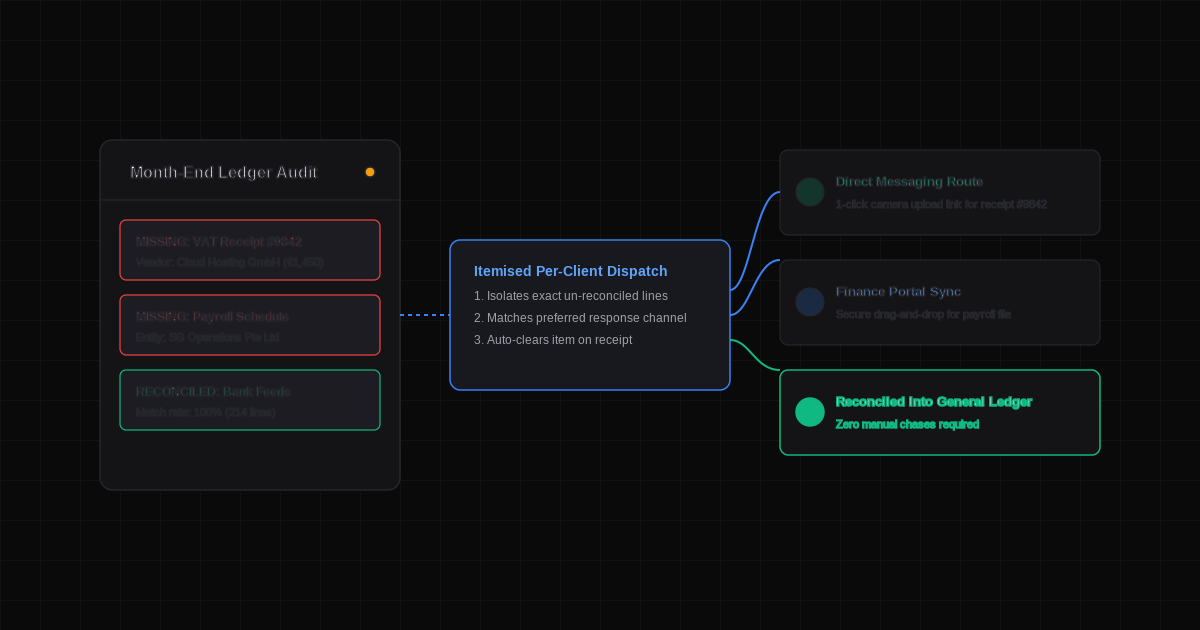
The process starts inside the accounting ledger or bank feed, not in an email draft. As bank transactions synchronize, the system evaluates each transaction against existing receipt records.
Instead of an accountant manually reviewing hundreds of statement lines with a highlighter, the logic isolates the exact items that lack supporting documentation. It notes the date, the counterparty name, the exact currency amount, and the transaction reference. If an expense from a known vendor appears without an invoice, the system logs a single open document item rather than a generic flag.
Step 2: Generating Per-Client Itemised Lists
Once the gaps are identified, the system compiles a specific, concise checklist for that client.
Rather than asking for "February expenses," the request presents three precise questions:
- "We have a card payment on February 14 for €1,450 to Cloud Hosting GmbH. Please upload the receipt."
- "We see a wire transfer on February 18 for £4,200 to Apex Logistics. Please provide the bill of lading."
- "The January payroll summary is needed to reconcile your statutory wage filings."
The client is never asked to think or investigate. They are given a targeted question that can be answered in thirty seconds.
Step 3: Delivering Through the Client's Preferred Channel
The itemised checklist is routed through the specific channel the client actually uses.
For a client who operates on mobile, the request arrives via a secure direct messaging link. Clicking the link does not require remembering a complex portal password or navigating a heavy enterprise interface. It opens a secure, authenticated mobile page showing only the three missing items. The user taps the first item, uses their smartphone camera to snap a photo of the receipt, and hits submit.
For corporate clients with established finance teams, the system routes structured requests directly into their shared Slack or Teams channel, or syncs directly with their existing enterprise document drive.
Step 4: Instant Ledger Reconciliation and Auto-Closing
The moment the client submits a file, the system matches the document against the open ledger transaction.
When the receipt for the €1,450 payment is uploaded, the item immediately vanishes from the client's outstanding checklist. If another reminder is scheduled to go out forty-eight hours later, the updated message only lists the remaining items. The client never receives a follow-up for a document they have already provided.
Once all items are cleared, the system notifies the assigned accountant that the file is complete and ready for final review and sign-off.
What Shifts for the Firm
When an advisory practice moves from manual document chasing to an automated, itemised collection flow, the operating model fundamentally changes.
Senior team members reclaim hours of administrative time each week. They no longer spend their mornings comparing bank feeds to shared folders or writing apology emails for misplaced attachments. Their capacity expands, allowing the firm to onboard new clients without immediately hiring additional support staff.
The month-end close timeline shrinks dramatically. Because clients can resolve specific document requests in seconds from their phones, response times drop from days to hours. Year-end statutory audits become routine verifications rather than multi-week rescue operations, because every ledger entry is tethered to its verified source document at the point of reconciliation.
Crucially, the client experience improves. Clients perceive the firm as organized, modern, and respectful of their time. Instead of dreading the monthly back-and-forth, they experience a streamlined interaction that takes two minutes of attention on their preferred device.
The Engineering Behind the Practice
Building this workflow requires connecting systems that usually operate in isolation. The core accounting software, the banking feeds, the client relationship database, and the messaging channels must function as an integrated operational loop.
At Kalvron, this is the architecture we implement for professional services and accounting firms. Rather than forcing clients into another cumbersome standalone software portal they will forget to check, we build custom AI workflows directly into the tools the firm and its clients already use every day.
The system reads ledger gaps directly from the practice management software, constructs precise per-client requests, dispatches them across the client's verified communication channels, and verifies incoming uploads against transactions in real time.
When document collection becomes an automated operational background process, accounting professionals can return to their actual mandate: delivering sound financial judgment, proactive advisory services, and strategic clarity to the businesses they serve.
Find out what your business can stop doing by hand.
In 20 minutes, we map your workflow and show you where an AI OS fits. No pitch. Just the diagnosis.
Book a call