Reporting Without Reporters: Cutting the Hours Spent Building Weekly Packs
Every Monday morning, executive leadership teams sit down in boardrooms and video conferences to review company performance.
They open dense presentation decks and spreadsheet packs: sales pipeline progression, gross margin realization, project delivery milestones, cash collection figures, and support ticket queues.
The objective of the meeting is sound: to evaluate where the business stands, identify emerging operational risks, and allocate resources effectively.
Yet behind that polished Monday morning slide deck sits an enormous, largely invisible administrative tax.
To assemble that single reporting pack, department managers, business analysts, and team leads spent the preceding Thursday and Friday functioning as full-time transcription clerks.
They logged into CRM platforms, ERP ledgers, ticketing tools, and bank portals. They exported raw CSV files, pasted tables into spreadsheets, wrote lookup formulas to reconcile mismatched accounts, formatted presentation charts, and typed commentary explaining why numbers changed since last week.
By the time the reporting pack is finally distributed on Sunday evening, hundreds of high-value leadership hours have been consumed.
Worse still, the numbers are already stale. The data reflects a snapshot taken three days prior. If an operational crisis occurred over the weekend or a key client flagged a major project dispute on Monday morning, the executive deck knows nothing about it.
Attempting to solve reporting overhead by teaching staff to build slide decks faster misses the point entirely.
The goal is not to accelerate the manual compilation process. The goal is to eliminate compilation altogether through modern operational architecture that allows organizations to automate management reporting directly from the source.
The failure of the compilation model
To understand why traditional management reporting is broken, examine how data moves through a typical mid-sized enterprise.
In most organizations, data does not flow programmatically into leadership views. It travels through human intermediaries who act as manual data couriers:
1. The data latency penalty
When reporting relies on human aggregation, latency is inevitable. A sales opportunity is closed on Wednesday. The salesperson logs it on Friday afternoon. The sales operations manager compiles it on Saturday.
The executive team reviews it on Monday. A full week elapses between operational reality and executive visibility.
When market conditions shift or client projects stall, leadership discovers the problem days after it began, leaving them in a perpetual state of reactive firefighting.
2. The spreadsheet reconciliation trap
Because different departments use specialized software tools, numbers rarely agree out of the box. Finance reports one revenue figure based on invoiced billings; sales reports another based on closed contract values; operations reports a third based on completed project milestones.
Hours are wasted in status meetings arguing over whose spreadsheet is accurate, rather than making strategic decisions to move the business forward.
3. Subjective narrative filtering
When managers manually build weekly reports, human psychology inevitably intervenes. Bad news is softened; slipped milestones are re-labeled as "in progress"; declining pipeline conversion rates are explained away with optimistic narrative commentary.
Executive leadership receives a curated, sanitized version of operational reality rather than cold, objective facts.
Reporting without compilation: The direct-telemetry approach
Eliminating reporting overhead requires a fundamental architectural shift: moving from episodic batch compilation to continuous operational telemetry.
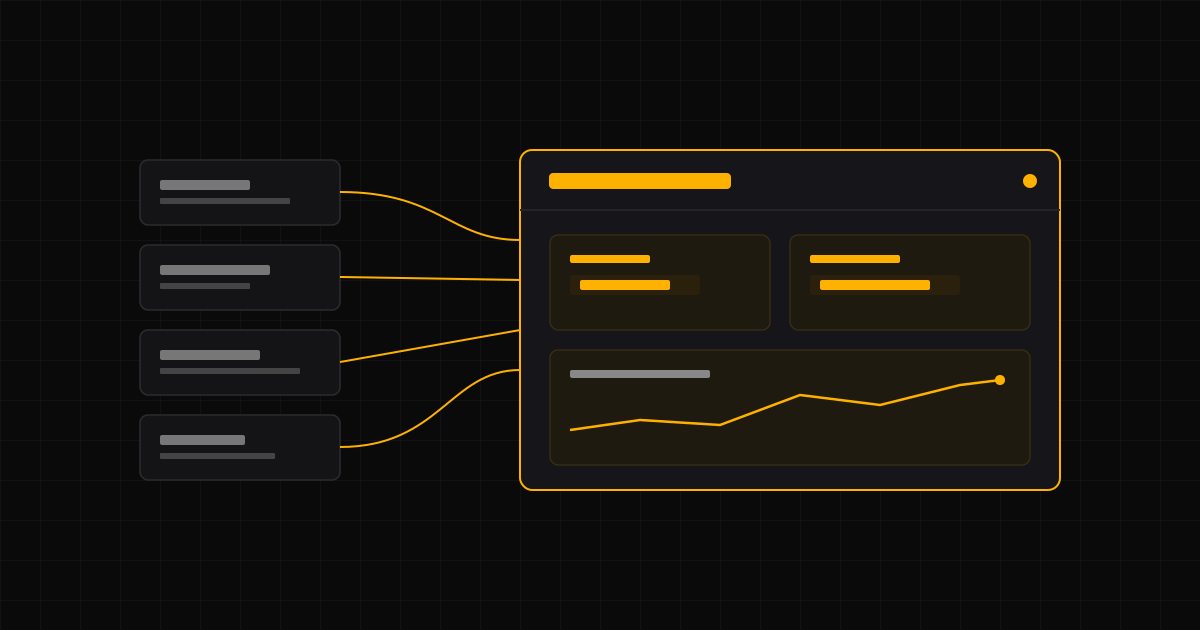
In a modern operating architecture, a report is not a document assembled by an analyst. It is an active, real-time query executed directly against the underlying systems where work actually happens.
The operational sequence unfolds across three foundational stages:
1. Ingesting live operational events at the source
Every business event generates an immediate digital footprint:
- A sales contract is digitally signed.
- A vendor invoice is approved in accounts payable.
- A customer support ticket is escalated.
- A milestone is accepted in project tracking software.
Rather than waiting for staff to summarize these events at the end of the week, an automated operational layer listens to these events in real time, capturing structured telemetry the second the transaction occurs.
2. Programmatic normalization across department ledgers
Instead of an analyst spending Friday building lookup formulas in Excel, automated data pipelines reconcile records continuously.
A signed agreement in the CRM synchronizes instantly with debtor records in the accounting ledger and delivery milestones in operations software. Discrepancies are flagged and resolved during the week, ensuring that corporate data remains reconciled at all times.
3. Self-compiling executive intelligence
With underlying operational data continuously unified and reconciled, management briefings compile programmatically.
The system tracks organizational metrics against defined targets, detects emerging anomalies (such as an account receivable aging past thirty days or an onboarding queue exceeding capacity), and synthesizes a concise, structured executive summary automatically.
Leadership does not wait for a weekly presentation pack. They open their dashboard at any moment and see the exact, unfiltered truth of the business in real time.
What happens when you remove the reporting tax
When an enterprise eliminates manual report compilation, the operational return compounds rapidly across the entire organization:
Reclaiming high-value leadership capacity
Department heads and analysts recover ten to fifteen hours each week previously lost to clerical document preparation.
Instead of formatting PowerPoint slides and copying spreadsheet rows, leaders spend their time coaching team members, improving client delivery, and executing strategic initiatives.
Shifting meetings from status checks to decision-making
Monday morning meetings transform completely. Because every leader already has access to verified, real-time operational data, teams no longer spend forty minutes reading slides to discover what happened last week.
Meetings become focused, high-leverage working sessions dedicated to resolving specific, flagged exceptions and executing tactical decisions.
Accelerating organizational response velocity
When leadership has real-time visibility into operational telemetry, intervention cycles collapse.
If client delivery velocity begins to drop on Tuesday, management intervenes on Tuesday afternoon, rather than discovering the failure during next week's formal review. Emerging operational risks are neutralized before they impact customer relationships or quarterly financial performance.
Management reporting should never be an administrative burden that drains the energy of your most capable leaders. It should be the continuous, automated pulse of your operational engine.
This is the kind of work Kalvron builds systems to run continuously. By deploying connected AI systems that unify telemetry across sales, finance, operations, and support, organizations eliminate manual report compilation, recover valuable leadership hours, and give executives live, unfiltered operational visibility.
Find out what your business can stop doing by hand.
In 20 minutes, we map your workflow and show you where an AI OS fits. No pitch. Just the diagnosis.
Book a call