Proposal and RFP Responses Without the Scramble
When a large enterprise or government agency issues a Request for Proposal (RFP), it represents a major commercial opportunity.
Yet inside most mid-to-large businesses, the arrival of an RFP does not trigger excitement; it triggers operational panic.
The tender document contains eighty pages of intricate technical specifications, security requirements, governance questionnaires, and compliance declarations. The submission deadline is two weeks away. What follows is a chaotic, high-stress scramble across the entire organization.
Sales leads desperately message senior engineers on chat apps, begging for updated system architecture descriptions. Compliance officers hunt through past email threads to find the latest ISO certification numbers. Operations managers stay late trying to rewrite service level agreement (SLA) commitments that someone wrote for a different bid six months earlier.
Inevitably, the submission comes down to the final hours. Proposals are assembled in a frantic copy-paste rush, leading to embarrassing errors: old client names left in the text, inconsistent pricing models, and poorly drafted technical answers. Worse, valuable bids are abandoned entirely simply because the team ran out of hours to complete the paperwork.
The scramble is not caused by a lack of commercial ambition. It happens because organizations treat every RFP response as a bespoke creative writing exercise, rebuilding standard company knowledge from scratch every single time.
The True Cost of Proposal Disorganization
When an enterprise lacks a structured proposal engine, the commercial damage impacts both growth and profitability:
1. Depressed Win Rates and Brand Damage
When technical and compliance answers are rushed together at midnight before a deadline, the quality suffers. Answers become superficial, formatting is inconsistent, and subtle tender criteria are overlooked. Procurement committees scoring competitive bids detect the lack of polish immediately. Losing a multi-million-euro contract due to sloppy documentation is an expensive failure.
2. High Opportunity Cost for Technical Leadership
An RFP requires answers that only experienced practitioners know: security architects, operations heads, legal counsel, and product directors. When these high-value leaders spend fifteen hours a week repeatedly answering the exact same questions about data encryption, disaster recovery, and organizational policies, their core strategic work stalls.
3. Turning Away Qualified Bids
Perhaps the highest cost is the bids that never get submitted. Sales directors review high-potential tenders and decide not to participate simply because the internal team does not have the administrative bandwidth to complete the response before the deadline. Constraining corporate revenue by the speed of manual typing is an artificial bottleneck on business growth.
The Architecture of Structured Proposal Assembly
Eighty percent of the questions in any standard commercial RFP are not unique. They cover predictable, recurring topics: data residency, financial stability, corporate governance, implementation methodology, security protocols, and standard SLA metrics.
Eliminating the scramble does not require replacing human expertise; it requires transforming fragmented institutional memory into an audited, reusable knowledge repository with automated assembly workflows.
Modern rfp response automation operates through four structured operational phases:
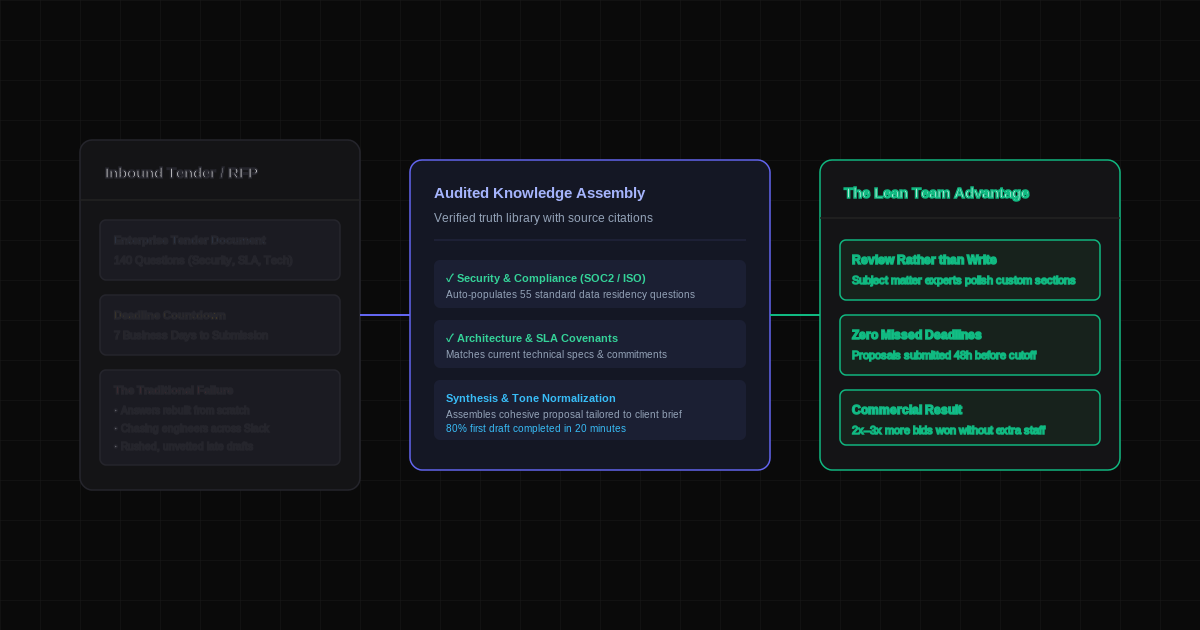
[Inbound Tender Document] (PDF / Word / Online Portal)
        ↓
[Question Decomposition & Categorization] (Security, Tech, Commercial, SLA)
        ↓
[Vector Knowledge Retrieval] (Matches against audited, up-to-date answers)
        ↓
[Contextual Draft Generation] (Assembles tailored first-pass response in minutes)
        ↓
[Human Expert Verification & Polish] (SMEs refine bespoke 20% only)
Phase 1: Automated Tender Decomposition
When a tender document arrives, the system parses the file and decomposes it into individual, trackable requirements.
It extracts every single compliance question, technical requirement, and submission parameter into a structured working matrix. Instead of team members manually reading through eighty pages with highlighters to find the deliverables, the system compiles a complete breakdown of every required item, noting word count limits, mandatory attachments, and specific evaluation criteria.
Phase 2: Vector Search Against Audited Truth
The core of the system is a centralized, continuously verified knowledge repository.
This repository contains the company's approved, up-to-date operational facts:
- Information security certifications, penetration test dates, and encryption standards
- Technical infrastructure architecture, redundancy parameters, and uptime statistics
- Standard service level agreements, escalation pathways, and governance hierarchies
- Executive bios, company registration data, and client references
When the system processes an RFP question—such as "Describe your disaster recovery protocols and Recovery Time Objective (RTO)"—it performs contextual retrieval against the verified knowledge base. It identifies the most recent, approved answer written by the technical team, complete with verified data points and relevant compliance attachments.
Crucially, every retrieved answer retains an audit trail: who approved the text, when it was last updated, and which source document verifies its accuracy.
Phase 3: Automated First-Draft Synthesis
Rather than pasting raw chunks of text, the system synthesizes the verified knowledge into a cohesive, customized response tailored to the prospective client's specific terminology and tone.
If the prospective client refers to their customer base as "citizens" or "passengers" rather than "users," the system aligns the terminology throughout the response. If the tender stipulates a maximum response length of two hundred words, the system concise-formats the verified facts to fit the exact constraint.
Within minutes of ingesting an RFP, the commercial team has an eighty-percent-complete, highly accurate first draft ready for review.
Phase 4: Structured SME Review and Deadline Enforcement
With the repetitive administrative heavy lifting handled by the system, the operational dynamic shifts entirely:
Subject matter experts (SMEs)—such as chief information security officers or operations directors—are no longer asked to write answers from a blank page. Instead, they are tagged only for the specific questions that require their unique domain insight, or where a bespoke client requirement deviates from standard operations.
The system manages the project timeline dynamically:
- It tracks the countdown to the submission deadline.
- It automatically reminds assignees of open review sections well before deadlines approach.
- It highlights sections that lack sufficient knowledge base documentation, allowing leadership to address strategic gaps early in the bid cycle.
Technical leaders spend twenty minutes reviewing and refining pre-assembled answers, rather than hours drafting text from scratch.
The Commercial Transformation
When a business replaces the last-minute RFP scramble with an automated, structured response pipeline, the impact ripples across the entire commercial operation:
- Proposal Output Doubles or Triples: Lean commercial teams can respond to twice as many qualified tenders in half the calendar time, expanding the top-of-funnel pipeline without hiring dedicated bid-writing staff.
- Win Rates Increase: Submissions are consistently comprehensive, professional, and accurate. The team has ample time to focus on the truly strategic sections—custom pricing, value propositions, and relationship nuance—rather than exhausting their energy on compliance tables.
- Executive and SME Morale Recovers: Senior technical leaders are freed from repetitive administrative questionnaires, allowing them to focus on engineering, client delivery, and strategic innovation.
- Knowledge Never Leaves the Firm: When a senior salesperson or operations director moves on, their domain knowledge remains safely indexed in the enterprise repository, rather than disappearing with their laptop.
How Kalvron Transforms Proposal Operations
At Kalvron, we engineer bespoke AI systems that run sales, operations, and technical workflows as a unified layer inside the tools your organization already uses.
We do not provide generic chat interfaces that invent unverified answers or hallucinate technical capabilities. We design and implement secure, private proposal engines grounded strictly in your company's audited operational facts.
Our systems index your historical bids, extract compliance truths from your master technical repositories, and automate the end-to-end assembly of tenders—all within your private security boundary, ensuring complete compliance with data confidentiality standards across Europe, Singapore, Malaysia, and the Gulf.
Stop letting valuable commercial opportunities turn into stressful operational emergencies. By turning your institutional knowledge into an automated proposal engine, you submit better bids faster, protect your leadership's time, and win more business with calm, repeatable precision.
Find out what your business can stop doing by hand.
In 20 minutes, we map your workflow and show you where an AI OS fits. No pitch. Just the diagnosis.
Book a call