Meeting Follow-Ups: Turning Decisions Into Tasks That Get Done
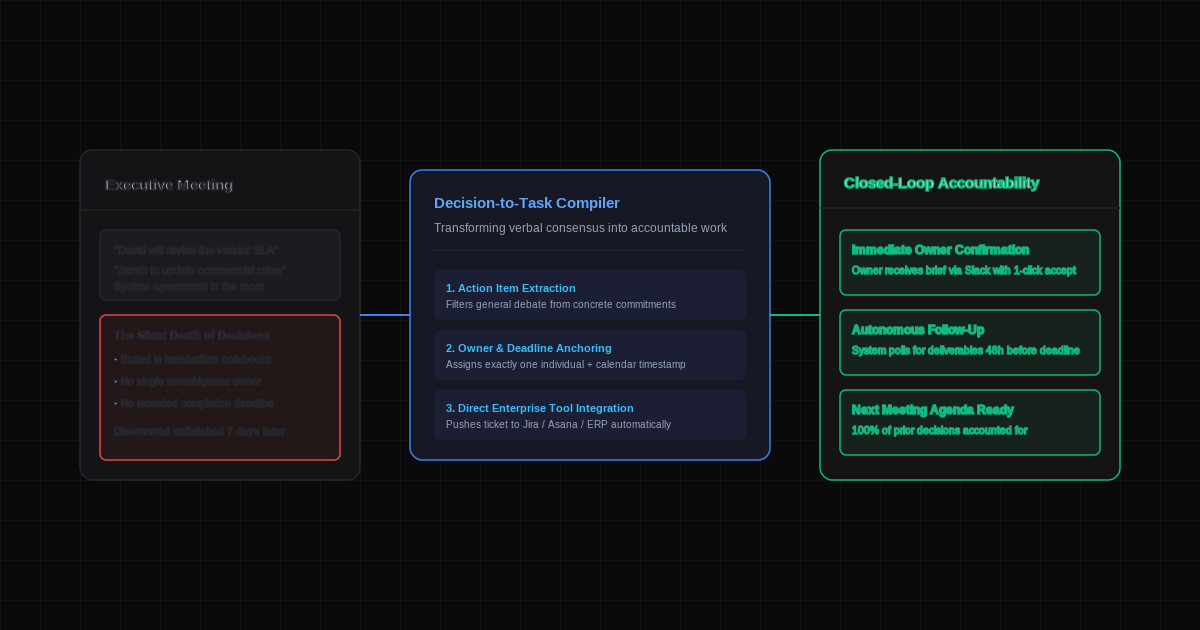
Consider the familiar ritual that takes place every week in executive boardrooms and management video calls.
Eight senior leaders spend sixty minutes discussing critical operational challenges. They analyze customer churn, evaluate supplier delays, and debate pricing strategies. Good ideas are voiced, consensus is reached, and everyone nods in agreement.
"David, can you review the vendor contract and renegotiate those payment terms before next month?"
"Sarah, let's make sure the revised logistics rate card is distributed to the sales team by Friday."
"Mark, please investigate why the warehouse fulfillment times slipped last week."
The meeting concludes on a high note of alignment and shared purpose. Laptops are closed. People walk back to their desks or jump onto their next call.
Then, ordinary daily operations take over.
Seven days later, the exact same group gathers for the next scheduled meeting. When the managing director asks about the status of the vendor contract, the rate card, or the warehouse audit, the room falls silent. David thought legal was handling the contract. Sarah was waiting for a final email confirmation that never came. Mark wrote a note in his personal journal, but it was buried beneath thirty urgent customer escalations.
The decisions made out loud in the prior meeting didn't fail because people were lazy. They died quietly because verbal agreements are not operational workflows.
The Compounding Cost of the Execution Gap
When an organization fails to convert meeting decisions into disciplined execution, the cost is rarely measured in hours spent in the conference room. It is measured in lost momentum and operational drift:
1. The Endless Meeting Loop
When decisions are not tracked and executed, the exact same topics must be discussed repeatedly across consecutive weeks. High-value leaders spend hours debating issues they already solved seven days earlier. The business burns executive capital rehashing old ground instead of tackling new commercial opportunities.
2. Strategic Paralysis
Company strategy is not defined by what is written in pitch decks; it is defined by what actually gets executed. When foundational operational tasks—such as updating customer terms, auditing supply costs, or deploying software patches—slip from week to week, larger strategic initiatives stall. Projects drag on months past their target completion dates.
3. Cultural Erosion of Accountability
When leaders observe that commitments made in meetings carry no consequence if forgotten, accountability across the entire organization decays. "Agreeing" to do something in a meeting becomes a social performance rather than a binding operational contract. Subordinate teams sense the lack of follow-through and mirror the behavior in their own daily work.
Why Personal Notes and Meeting Minutes Fail
Most companies attempt to solve this execution gap through two traditional methods: relying on individual notes, or assigning someone to circulate "meeting minutes."
Both methods consistently fail for predictable operational reasons:
1. The Black Hole of Personal Notebooks
When an executive jots down an action item in a paper notebook or personal note-taking app, that task is completely invisible to the rest of the organization. There is no shared transparency. No one else knows what was committed to, no one can see whether progress is being made, and no system exists to send a reminder before the deadline arrives.
2. Passive, Narrative Meeting Minutes
Having an administrative assistant take detailed notes and email a three-page PDF of "minutes" forty-eight hours later is largely useless.
Executives do not read lengthy meeting summaries. The document lands in an already overwhelmed inbox, where it sits unread. Crucially, a bullet point in an email is passive; it does not assign a task into an enterprise project management tool, it does not set calendar reminders, and it does not establish an automated follow-up cadence.
Transforming verbal decisions into completed operational work requires an automated bridge between the spoken conversation and the company's task execution software.
The Architecture of Autonomous Action Item Enforcement
A reliable meeting action items follow up system does not rely on human memory or administrative chasing. It automates the extraction, assignment, and ongoing verification of commitments through four distinct phases:
[Meeting Audio / Transcript / Notes]
        ↓
[Semantic Action Item Extraction] (Separates discussion from commitments)
        ↓
[Assignment & Deadline Anchoring] (Single owner, explicit calendar deadline)
        ↓
[Direct System Integration] (Pushes task into Jira, Asana, ERP, or CRM)
        ↓
[Closed-Loop Verification] (Automated check-ins & status reporting for next agenda)
Phase 1: Semantic Decision Extraction
During a sixty-minute operational meeting, thousands of words are spoken. Ninety percent of that dialogue is context, debate, background analysis, and brainstorming. Only ten percent represents concrete, actionable commitments.
The extraction engine analyzes the meeting transcript or summary notes to isolate binding operational decisions from general conversation:
- It ignores exploratory statements: "We might want to think about reviewing the supplier terms next quarter."
- It captures explicit commitments: "David will review the Apex Logistics contract and submit revised payment terms by Friday at 5:00 PM."
The system extracts the four mandatory attributes of an executable task: the objective, the single individual who owns it, the required deliverable, and the exact completion deadline.
Phase 2: Instant Owner Confirmation
Within minutes of the meeting's conclusion, the system does not blast an irrelevant summary to all attendees. It generates targeted, individual briefings.
David receives a brief, direct notification on his preferred communication channel (such as Slack, Microsoft Teams, or email):
"During today's Executive Operations Meeting, you committed to: Review Apex Logistics contract and submit revised payment terms. Deadline: Friday, 5:00 PM."
The message includes a single-click button: [Acknowledge Commitment] or [Request Clarification].
By acknowledging the task immediately after the meeting, the owner confirms ownership while the context is fresh, removing ambiguity before the work even begins.
Phase 3: Direct Injection into the System of Record
An action item that only lives in a chat message will still be forgotten once daily firefighting begins.
The moment the commitment is acknowledged, the system automatically pushes the task directly into the enterprise tool where that individual actually manages their daily workflow—whether that is an ERP task queue, Jira, Asana, Monday.com, or a commercial CRM.
The task is created with its full operational context:
- Direct links to the relevant supplier contract or client file
- Explicit due dates synchronized with corporate calendars
- Standard operational tags that allow leadership to track cross-departmental dependencies
The decision is no longer floating in the ether; it is an anchored, tracked record inside the plumbing of the business.
Phase 4: Closed-Loop Automated Chasing and Agenda Preparation
The final and most critical phase is automated verification:
Forty-eight hours before the task is due, the system performs a gentle, automated check-in with the owner, asking if they have what they need to complete the deliverable. If the task is completed and marked done in the enterprise software, the system logs the completion record.
If a task is at risk of missing its deadline, the system flags the bottleneck to the project lead early, allowing the team to unblock the issue before the deadline lapses.
When the executive team gathers for the next weekly meeting, the system automatically compiles the opening agenda:
- It lists every single commitment made in the prior session.
- It displays verified completion statuses directly from the enterprise task system.
- It highlights only the items that encountered genuine operational roadblocks.
The meeting begins with five minutes of clear accountability, rather than thirty minutes of uncomfortable excuses.
The Cultural and Operational Payoff
When an enterprise bridges the gap between meeting consensus and task execution, the organization accelerates:
- Decisions Stick: The company eliminates the exhausting cycle of discussing the same unresolved issues week after week. Once an operational decision is made, it moves systematically to completion.
- Velocity Increases: Strategic initiatives and operational corrections that previously drifted for months are executed in days, allowing the business to out-maneuver slower competitors.
- Accountability Becomes Frictionless: Team members know exactly what they own, when it is due, and that their completed work will be recognized transparently. Accountability ceases to be a stressful confrontation and becomes a calm, automated norm.
- Executive Time Is Reclaimed: Senior leaders spend less time chasing colleagues for status updates and more time delivering high-impact strategic guidance.
How Kalvron Turns Strategy Into Execution
At Kalvron, we believe that serious mid-to-large businesses succeed or fail based on execution velocity, not meeting duration.
We design, build, and deploy custom AI operational layers that connect your leadership communications, meeting environments, and enterprise management tools into a continuous, accountable workflow.
Our systems turn verbal agreements into tracked, owned enterprise tasks, handle the follow-up cadence automatically, and provide leadership with real-time operational visibility across Europe, Singapore, Malaysia, and the Gulf.
Stop letting valuable strategic decisions die quietly in forgotten notebooks. By building an automated bridge from meeting room decisions to verifiable operational execution, you ensure that when your leadership team says something will get done, it actually gets done.
Find out what your business can stop doing by hand.
In 20 minutes, we map your workflow and show you where an AI OS fits. No pitch. Just the diagnosis.
Book a call